
By Tim Smith
I did not go out and run on the day it was -50 F. Instead I went out and skied.
It was our third day in Alaska and I was still figuring out how to dress for cold weather. So I bundled myself up in wool socks, long-john, thick wool pants, thermal shirt, flannel shirt, wool sweater, coat, gloves, over-mittens and stocking cap. And, of course, backcountry ski boot, skis and poles.
Our cabin is on the banks of the Chena River and I skied up-stream into an ice fog, which smeared the sun into a golden wash. And after three-quarters of a mile of hard work, breaking trail in a foot of powder, I was warm.
The key to running or skiing in Alaska, or anyplace with extreme cold, is the balance between how hard you work, how much heat you produce, how cold is the day and how many layers you wear.
So here I am slipping in a bit of physics (I can’t stop thinking like a physicist just because I am writing about running). The average person sitting still produces about 100 Watts of heat. A runner produces more heat, depending on how hard you are running and how big you are. As a rule of thumb, you produce 60-100 Watts/mph. So if you’re running at 8 mph, your engine is using 480 to 800 Watts, and most of that goes off as heat. So imagine that inside your running tights and jacket there is a hairdryer set at its lowest setting, it is about that much heat.
When I was running TNT at Occum Pond in December I would typically wear a pair of running tights, an underlayer shirt and my tight wove running jacket. When I run in Alaska at -10 to -25 F I wear 2 layers of running tights, 1 thick and 1 thinner underlay shirt and my running jacket, light(ish) gloves and hat or head band.
I’m also wearing “icebugs”, running shoes which are slightly insulated and have steel studs. I think about two-thirds of the people in the local running club wear icebugs. We run on a lot of very hard packed and icy snow.
I think the most difficult part of running in the cold — same as in the Upper Valley — is “taking the plunge”. At the moment you step outside the door your body is only producing that minimal 100 Watts, but you have a few minutes of heat stored in your warm clothing. A mile or two later I am toasty, but in that first ten minutes my skin is getting colder while my furnace is just starting to get stoked. From two minutes to ten minutes it really can be cold. At -20 the fingers are aching and it is only faith in future warmth which keeps one from turning back.
On one occasion I went with three layers, which ment that first ten minutes was not as severe. But by thirty minutes I was gushing sweat and at forty minutes I was getting chilled due to being wet.
All of this is also true in the upper valley. I think the difference is in that in Alaska, in that first ten minute “plunge” I get colder, much colder, and the rest of the time I am running on slippery surfaces.
Running Club North
——————
There is no better way of walking into a community and immediately being accepted than to join a running club. If you can finish the workout without too much griping, you are given a thumbs up, a stamp of approval. I like clubs because nobody complains about stuff being too hard; you don’t have to be here. If the runs bothers someone – they just stop showing up. Also clubs are made of a diverse swath of people. I’ve met chiropractors, wildlife biologist, construction workers, intellectual property people, army officers and soldiers and so on. I hear about all sorts of different sides of Fairbanks.
So upon arriving in Fairbanks I joined the local running club, “Running Club North”. There is a lot of similarity between RCN and UVRC. The two clubs are about the same size, but there are a few distinct differences. RCN recently celebrated its 50th anniversary and as far as I can tell, there are almost no purely running event within 100 miles in which the club is not involved. (There are combination events, like the “White Mountains 100” which you can bike, ski or run, which are independent of the club). The club even provides officials for all the local high school and middle school track and cross country meets.
The club’s flagship event is the “Equinox Marathon” in September (I’ll let you figure out the date). But there is a small race almost every other weekend.
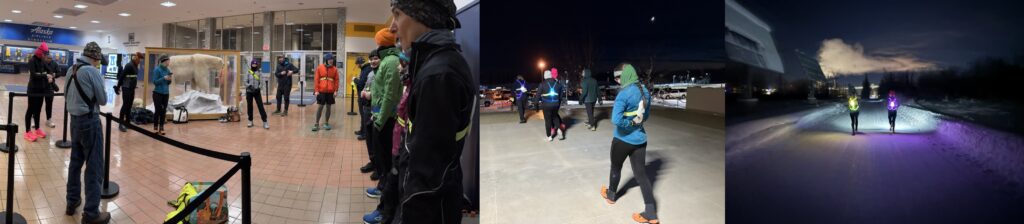
For me the most important event is the weekly “Fahrenheit Be Darned”, the winter (26 weeks) Wednesday evening running series. We meet at the “Patty Center”, which is the main gymnasium for the University of Alaska – Fairbanks (UAF) at 5:45. George, our coach, waits for us in the lobby and generally 12 to 15 of us show up.
George has been with the club for decades. He is originally from Maine, but told me once that the best thing which ever happened to him was he was accepted at UAF and rejected from some local colleges. So as a teenager he moved from Maine to Alaska and never looked back. He reminds me a lot of UVRC’s Jim Burnnet.
In the lobby we drop our coats as George describes a loop which he and Ed have checked out, “It looks like the commuter trail next to the Park’s Highway is clear”, or “up Sheep Creek”, or “to the Ballaine and Farmer’s Loop junction.”And then we slip on our gloves and pull down are hats and head to the door. There is always a clatter as we cross the tiles; most of us are wearing studded shoes. Then at the doors – it feels like an airlock into the cold, black, outer space – we switch on our light vest and launch into the cold. There is no standing around outside.
“Fahrenheit Be Darned” are simple runs, usually six to eight miles long. But since we run in snow it feels like a longer workout. I’ve been running with Kelsi. She was part of the same group when I ran here three years ago. Besides running, Kelsi coaches Ski-joring. This is cross-country skiing (either classic or skate) while being towed by a dog, or a team of dogs.
George watches our stuff in the lobby and when we return there is a large hot water thermos and packs of hot chocolate mix, cups and stirring spoons.
There is also a Thursday run from Hoodoo Brewery. I’ve only made that event once. A four mile run through small streets, over a footbridge across the Chena River, then on the River Walk to the dog park and back to the brewery. With 200 meters to go I reminded people that this was suppose to be a race, and so I started kicking it in. Eric and Mike rose to the challenge and then Stephanie rose well beyond the challenge and despite the icy footing blazed past everyone else in our pack.
There is an outdoor gas fire pit at the brewery where we all stood around, despite it being -15F, for a while, until we stopped sweating. The brewery has is a rotation of “food trucks”. In the summer the trucks are set up near the fire pits, but in the winter the truck’s vendors set up in an inside corner of the pub. It was the “Alaskan Tacos” truck the night I was there.
There is a small race almost every other weekend through the winter, and a snowshoes race on the weekends between.
I ran in the “Airport Run”; 4 of us raced the 4 mile and 7 raced the 8 mile course. Justin started one of the stop watches, then sprinted to catch up with me. Sam, a young spud in the Army, who just graduated from college in Washington state, had already established a commanding lead in the 8 mile race. Justin and I both ran the 4 mile race, and battled each other in a most congenial way through the 2-mile turn around. He then broke me. It was a long, lonely, hot (+4 F) run home.
What’s Next?
————
I’ll miss the RCN winter banquet because I’ll be in Beaver, one of the tiny native villages a bit more then a hundred miles north of here, and seventy miles from the nearest road (in a straight line – a hundred if you follow the river). I’ll be there for the first week or so of February. I’ll be manning cameras for my wife’s rocket launch. The whole village has about a miles worth of roads. All unplowed, but well used by snowmachines. So I don’t know what to expect as far as running. But I’ll write about it for the UVRC March newsletter.
Also, if you are interested, I write a blog about my time in Alaska at
If you want to receive the announcement of new postings, just email me
timothy.p.smith@dartmouth.edu