
UVRC Newsletter Team
UVRC Newsletter Team
Articles
February Announcements
UVRC Registration – Have you renewed for 2026 yet?
You can sign up here: www.LebanonNH.gov/register
Log in, choose the Adult Sports & Programs tab, choose Upper Valley Running Club, then 2026 UVRC Membership (either individual or family rate).
You’ll notice an increase of $5.00 dollars across the board for all paid-for programming. This increase is to help with the behind-the-scenes work that Leb. Rec. does on a daily basis, from daily processing, general questions, website hosting, reimbursements, accounts payable, and more. Membership fees also go toward all the amazing programming below.
UVRC Membership includes:
- Social events throughout the year! And the opportunity to win prizes and swag!
- Weekly workouts with Tuesday Night Track (TNT)
- Runners Night Out (RNO) every 2nd Tuesday of the month at Hanover Brick & Brew with free slices and social time. Participation at TNT is not required in order to attend RNO.
- Saturday morning runs every weekend, meeting up either in front of Omer & Bob’s or at Colburn Park. (Rumor has it there are some tasty muffins being offered)
- A monthly newsletter featuring articles written by club members and board members. You can submit an article here.
- Connection on UVRC on social media platforms:
- Website: www.uppervalleyrunningclub.org
- Facebook: https://www.facebook.com/uppervalleyrunningclub
- Meetup: https://www.meetup.com/Upper-Valley-Running-Club and you can post a group run here on the message board or discussion board.
- Strava: https://www.strava.com/clubs/28353 and you can post a group run here on the POSTS section.
- Instagram: https://www.instagram.com/uppervalleyrunningclub/
- Competing as a team: Upper Valley Running Series (UVRS), New Hampshire Grand Prix (NHGP), and more!
- Access to training, coaches, and a running community that can help answer your questions.
- 10% off shoes, apparel, & other running-related gear discounts at Omer & Bob’s here in Lebanon, NH, a supporter of the club since the beginning.
- 10% discount on all regular-priced running shoes, socks, insoles, and running accessories at Stateline sports in West Lebanon, NH.
We look forward to your continued participation in UVRC and encourage joining a committee whether it is the social committee, volunteering, newsletter, UVRC gear planning, training, or race involvement. You can always email paul.coats@LebanonNH.gov or board presidents at contact@uppervalleyrunningclub.org.
Cara Baskin, Kristina Siladi, and Drew Prescott
Tri-UVRC Presidents
Updated Discount Code: Running Warehouse
As a UVRC member, you can enjoy a discount from Running Warehouse: 20% off clothing and socks and 10% off select clearance shoes, visors & hats, and nutrition. Enter code 2PK52FZT at checkout. Note: this is a new code as of January 1st.
Volunteer Challenge 2025
Congratulations to Susan Emerson, one of our volunteer Couch to 5k coaches, for winning this year’s volunteer challenge drawing! Susan won a pair of running shoes of her choice from Omer and Bob’s or Stateline Sports. See below to see how you can get into the running (pun intended) for next year’s drawing!)
Volunteer Challenge 2026
The challenge is on for 2026! Now with a new format! Details to come soon to an inbox near you!
Save the Date 6/27 – Volunteers Needed for Mount Washington Road Race
UVRC has provided volunteers for the Mount Washington Road Race for years, and we are hoping to round up another crew of amazing humans this year. The race is on Saturday, June 27th. We are in charge of post-race parking, as drivers bring runners back down to the starting area at the base. It’s a pretty easy gig, and in exchange, volunteers get all the feel-good vibes the volunteering brings about, and UVRC gets four bypass entries into the race for anyone who wants to run but does not get in via the lottery.
RELATED: Save the Date for the 2nd Annual UVRC Campout
UVRC will be hosting a campout at Barnes Field at the Dolly Copp Campground, just a few short miles from the start of the Mount Washington Road Race, June 26th-28th. It’s a great place for MWRR volunteers and racers to hang for the weekend, as well as anyone else who wants to spend a summer weekend in the Whites with some running friends! More details to come.
Covered Bridges Half Marathon lodging discount
Do you have friends or family coming into town for the Covered Bridges Half Marathon who need lodging? On the River Inn in Woodstock is offering a discount for racers and family/friends. Use the code EVENTS when booking, or reach out to Nikki at events@ontheriverwoodstock.com who can help you with your booking!
2026 Upper Valley Running Series
The 2026 Upper Valley Running Series (UVRS), brought to you by BE Fit Physical Therapy, is set and ready to go! The UVRS is our club series of local road (ish) races. You can get full information, and also check out full-series registration (25% off!), at the website:
If you’re too lazy to check the link, the series is:
- February 7: RedZone 5K (Wilder, VT)
- March 14: Shamrock Shuffle 5K (Lebanon, NH)
- April 12: Lake Morey Icebreaker 5M (Fairlee, VT)
- May 17: BarnArts Race Around the Lake 5K/10K (Barnard, VT)
- June 21: Skip’s Run 4M (Lebanon, NH)
- July 4: Red, White, and Blue 6.2 5K/10K (Lebanon, NH)
- August 30: Triple Dam 10K (Perkinsville, VT)
- September 12: Sprouty 5K/10K (Sharon, VT)
- October 10: Downriver Rail Run 10K (Lebanon, NH)
- October 25: Tiger Run 5K/12K (Enfield, NH)
- November 22: Turkey Trot 5K/10K (Hanover, NH)
Depending on when this newsletter comes out, the next race in the series may be the RedZone 5K in Wilder VT. A great race to kick off the series with, on the day before the Super Bowl. Check out full race information:
https://www.pinnaclestrive.com/index.php?n=ledyard_redzone_5k_2026
The next race after that is the Upper Valley classic, the Lebanon Shamrock Shuffle 5K.
Not running? Got a friend or family member who will be there but not running? Consider volunteering:
Happy Running!
Geoff and the UVRS committee
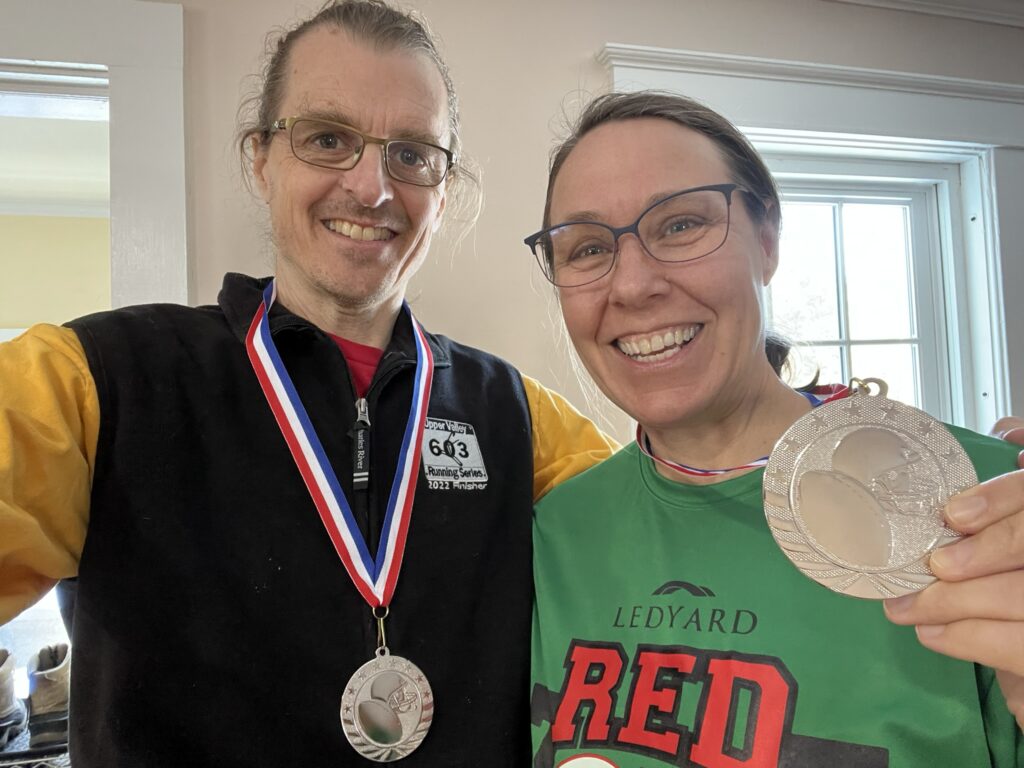
Race medals from the 2024 RedZone 5k
https://www.pinnaclestrive.com/index.php?n=ledyard_redzone_5k_2026
A Thousand Miles and a Spreadsheet
By Ryan Scelza
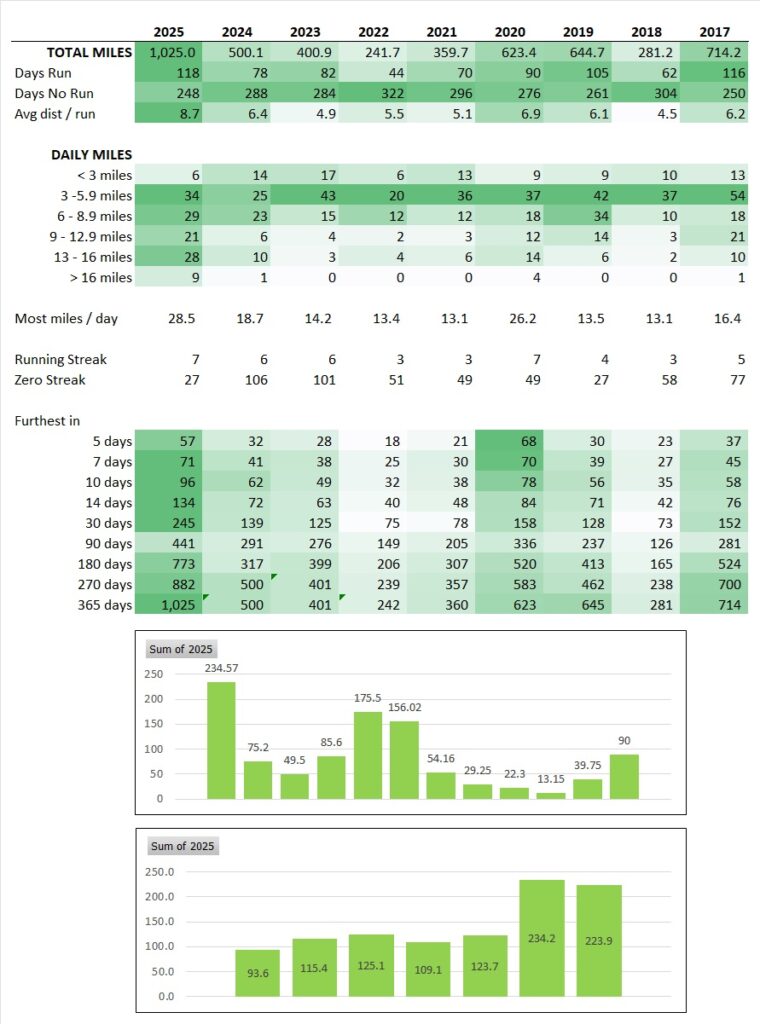
In 2025, I ran more than 1,000 miles for the first time. That number still surprises me a little, not because it is extraordinary, but because I don’t necessarily think of myself as a “serious” runner. I don’t structure my weeks around rigid training plans, I run races for fun, and most days my goal is simply to get out the door.
Having ended 2024 with consistent miles, I set a loose goal of 1,000-plus miles for the new year. As part of that, and what has allowed me to monitor progress, is how I track my miles. Since 2017, I have logged every run in an excel spreadsheet that has slowly evolved into something more detailed than I first intended. It captures daily mileage, days run versus days off, average distance per day, how often my runs fall into different distance ranges, my longest streaks (both running and not running), my biggest single-day efforts, and even the farthest I have run over rolling windows of time (7, 14, 30, 90 days, etc.). There are charts, there are tabs, but there’s also simplicity that never makes it feel like a burden.
While it’s detailed and interesting, none of this data really dictates how I train. I don’t wake up and consult a pivot table and the spreadsheet doesn’t drive my behavior so much as document it.
Late in 2025, a quick glance at my annual total made it clear I was falling short of that 1,000-mile goal. That visibility was enough to nudge me into running a little more consistently in the final weeks of the year, providing awareness and prompting a small adjustment.
My tracking, while not essential, has become a key part of my running life. I don’t think it does anything to help performance, but it helps to show how my running has changed over the years, how certain months are heavier than others, how weekdays differ from weekends, and how life subtly (re)shapes patterns. Looking back at the charts, it’s fun to see the miles, but to also think about the seasons, routines, disruptions, and returns.
What I’ve learned from my system is that data does not have to change behavior to be meaningful. It creates a record of effort, a sense of continuity, and sometimes a small bump when motivation slips. It’s less about performance and more about reflection, customized to my preferences.
I expect many UVRCers rely on tools like Strava, Garmin, or other apps to do this automatically, which I also use. Others may jot things down in a notebook, keep mental tallies, or not track at all. I would love to hear how others keep track of your running, if at all? What information matters to you? And has it changed over time? Feel free to reach out (ryan@scelza.com) if you’d like to share!
Reflecting on this provided a nice reminder that running, like the ways we document it, is personal, evolving, and uniquely our own.
Blame it on the Midnight Shame on the Moon
By Jim Burnett

Blame it on the Midnight, Shame on the Moon for
evoking emotional longings.
For conjuring unattainable dreams.
Leading only to heartbreak.
As with loving, so with running.
Yogis say, Observe and accept.
In meditation touch the rough surface of the back of your palate with the tip of your tongue.
In your mind draw a vertical line from there to the center of the frontal lobe.
Imagine a full moon floating there.
Relax.
Accept the moon as it is.
It is what it is.
Let your mind empty.
Let the tension in your neck and shoulders drain down your spine and onto the ground.
Left trailing behind.
Thinking of the wistful voice of Gordon Lightfoot. Intimate.
Reflective.
Singing, Blame it on the Midnight, Shame on the Moon…
Now.
Relaxed.
Running.
Floating.
Flipping the surface of the road back underneath you with your toes.
Ankles spinning like wheels.
The body – legs, torso, arms, brain – just along for the ride.
Did you ever feel like you could run forever?
Me too…
Question of the Month: Your Favorite Running Podcasts
This month, we asked for your favorite running-related and running-adjacent podcasts and social media accounts to help you pass those cold winter months. Here are some of what our teammates suggested:
I’m sure I won’t be the only one to suggest SWAP (Some Work, All Play), but the Roches are entertaining and offer great insights into coaching, performing, and science.
Ditto the Freetrail podcast.
The Trail Network podcast: https://podcasts.apple.com/us/podcast/the-trail-network-podcast/id1738325869
Not a running podcast, but this episode with Nick Thompson is great (as is Nick): https://podcasts.apple.com/us/podcast/3-takeaways/id1526080983?i=1000737218945
I might add a few good YouTube accounts:
- The Hemmings
- Jeff Pelletier
- Clayton Young
Dumb Runner! (Not a podcast, just a hilarious comic strip.) If we can’t make fun of ourselves, we can’t make fun of anyone!
Running in Alaska
By Tim Smith
I did not go out and run on the day it was -50 F. Instead I went out and skied.
It was our third day in Alaska and I was still figuring out how to dress for cold weather. So I bundled myself up in wool socks, long-john, thick wool pants, thermal shirt, flannel shirt, wool sweater, coat, gloves, over-mittens and stocking cap. And, of course, backcountry ski boot, skis and poles.
Our cabin is on the banks of the Chena River and I skied up-stream into an ice fog, which smeared the sun into a golden wash. And after three-quarters of a mile of hard work, breaking trail in a foot of powder, I was warm.
The key to running or skiing in Alaska, or anyplace with extreme cold, is the balance between how hard you work, how much heat you produce, how cold is the day and how many layers you wear.
So here I am slipping in a bit of physics (I can’t stop thinking like a physicist just because I am writing about running). The average person sitting still produces about 100 Watts of heat. A runner produces more heat, depending on how hard you are running and how big you are. As a rule of thumb, you produce 60-100 Watts/mph. So if you’re running at 8 mph, your engine is using 480 to 800 Watts, and most of that goes off as heat. So imagine that inside your running tights and jacket there is a hairdryer set at its lowest setting, it is about that much heat.
When I was running TNT at Occum Pond in December I would typically wear a pair of running tights, an underlayer shirt and my tight wove running jacket. When I run in Alaska at -10 to -25 F I wear 2 layers of running tights, 1 thick and 1 thinner underlay shirt and my running jacket, light(ish) gloves and hat or head band.
I’m also wearing “icebugs”, running shoes which are slightly insulated and have steel studs. I think about two-thirds of the people in the local running club wear icebugs. We run on a lot of very hard packed and icy snow.
I think the most difficult part of running in the cold — same as in the Upper Valley — is “taking the plunge”. At the moment you step outside the door your body is only producing that minimal 100 Watts, but you have a few minutes of heat stored in your warm clothing. A mile or two later I am toasty, but in that first ten minutes my skin is getting colder while my furnace is just starting to get stoked. From two minutes to ten minutes it really can be cold. At -20 the fingers are aching and it is only faith in future warmth which keeps one from turning back.
On one occasion I went with three layers, which ment that first ten minutes was not as severe. But by thirty minutes I was gushing sweat and at forty minutes I was getting chilled due to being wet.
All of this is also true in the upper valley. I think the difference is in that in Alaska, in that first ten minute “plunge” I get colder, much colder, and the rest of the time I am running on slippery surfaces.
Running Club North
——————
There is no better way of walking into a community and immediately being accepted than to join a running club. If you can finish the workout without too much griping, you are given a thumbs up, a stamp of approval. I like clubs because nobody complains about stuff being too hard; you don’t have to be here. If the runs bothers someone – they just stop showing up. Also clubs are made of a diverse swath of people. I’ve met chiropractors, wildlife biologist, construction workers, intellectual property people, army officers and soldiers and so on. I hear about all sorts of different sides of Fairbanks.
So upon arriving in Fairbanks I joined the local running club, “Running Club North”. There is a lot of similarity between RCN and UVRC. The two clubs are about the same size, but there are a few distinct differences. RCN recently celebrated its 50th anniversary and as far as I can tell, there are almost no purely running event within 100 miles in which the club is not involved. (There are combination events, like the “White Mountains 100” which you can bike, ski or run, which are independent of the club). The club even provides officials for all the local high school and middle school track and cross country meets.
The club’s flagship event is the “Equinox Marathon” in September (I’ll let you figure out the date). But there is a small race almost every other weekend.
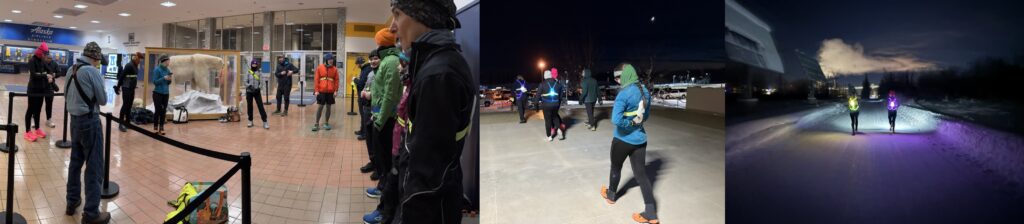
For me the most important event is the weekly “Fahrenheit Be Darned”, the winter (26 weeks) Wednesday evening running series. We meet at the “Patty Center”, which is the main gymnasium for the University of Alaska – Fairbanks (UAF) at 5:45. George, our coach, waits for us in the lobby and generally 12 to 15 of us show up.
George has been with the club for decades. He is originally from Maine, but told me once that the best thing which ever happened to him was he was accepted at UAF and rejected from some local colleges. So as a teenager he moved from Maine to Alaska and never looked back. He reminds me a lot of UVRC’s Jim Burnnet.
In the lobby we drop our coats as George describes a loop which he and Ed have checked out, “It looks like the commuter trail next to the Park’s Highway is clear”, or “up Sheep Creek”, or “to the Ballaine and Farmer’s Loop junction.”And then we slip on our gloves and pull down are hats and head to the door. There is always a clatter as we cross the tiles; most of us are wearing studded shoes. Then at the doors – it feels like an airlock into the cold, black, outer space – we switch on our light vest and launch into the cold. There is no standing around outside.
“Fahrenheit Be Darned” are simple runs, usually six to eight miles long. But since we run in snow it feels like a longer workout. I’ve been running with Kelsi. She was part of the same group when I ran here three years ago. Besides running, Kelsi coaches Ski-joring. This is cross-country skiing (either classic or skate) while being towed by a dog, or a team of dogs.
George watches our stuff in the lobby and when we return there is a large hot water thermos and packs of hot chocolate mix, cups and stirring spoons.
There is also a Thursday run from Hoodoo Brewery. I’ve only made that event once. A four mile run through small streets, over a footbridge across the Chena River, then on the River Walk to the dog park and back to the brewery. With 200 meters to go I reminded people that this was suppose to be a race, and so I started kicking it in. Eric and Mike rose to the challenge and then Stephanie rose well beyond the challenge and despite the icy footing blazed past everyone else in our pack.
There is an outdoor gas fire pit at the brewery where we all stood around, despite it being -15F, for a while, until we stopped sweating. The brewery has is a rotation of “food trucks”. In the summer the trucks are set up near the fire pits, but in the winter the truck’s vendors set up in an inside corner of the pub. It was the “Alaskan Tacos” truck the night I was there.
There is a small race almost every other weekend through the winter, and a snowshoes race on the weekends between.
I ran in the “Airport Run”; 4 of us raced the 4 mile and 7 raced the 8 mile course. Justin started one of the stop watches, then sprinted to catch up with me. Sam, a young spud in the Army, who just graduated from college in Washington state, had already established a commanding lead in the 8 mile race. Justin and I both ran the 4 mile race, and battled each other in a most congenial way through the 2-mile turn around. He then broke me. It was a long, lonely, hot (+4 F) run home.
What’s Next?
————
I’ll miss the RCN winter banquet because I’ll be in Beaver, one of the tiny native villages a bit more then a hundred miles north of here, and seventy miles from the nearest road (in a straight line – a hundred if you follow the river). I’ll be there for the first week or so of February. I’ll be manning cameras for my wife’s rocket launch. The whole village has about a miles worth of roads. All unplowed, but well used by snowmachines. So I don’t know what to expect as far as running. But I’ll write about it for the UVRC March newsletter.
Also, if you are interested, I write a blog about my time in Alaska at
If you want to receive the announcement of new postings, just email me
timothy.p.smith@dartmouth.edu