
By Ryan Scelza
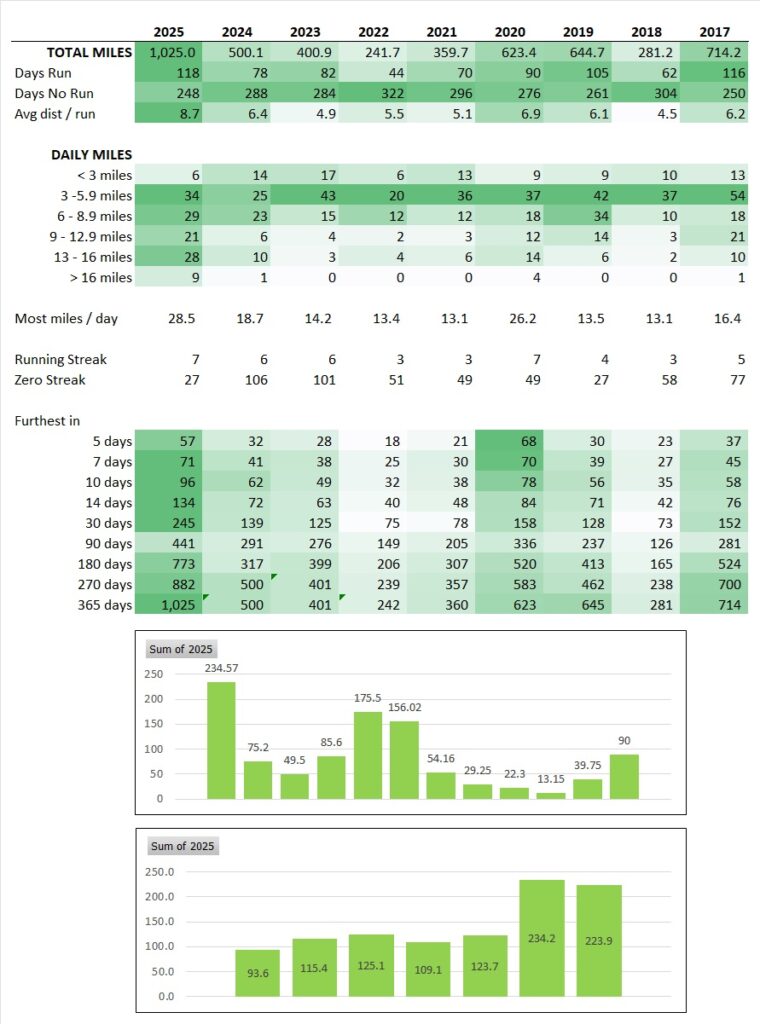
In 2025, I ran more than 1,000 miles for the first time. That number still surprises me a little, not because it is extraordinary, but because I don’t necessarily think of myself as a “serious” runner. I don’t structure my weeks around rigid training plans, I run races for fun, and most days my goal is simply to get out the door.
Having ended 2024 with consistent miles, I set a loose goal of 1,000-plus miles for the new year. As part of that, and what has allowed me to monitor progress, is how I track my miles. Since 2017, I have logged every run in an excel spreadsheet that has slowly evolved into something more detailed than I first intended. It captures daily mileage, days run versus days off, average distance per day, how often my runs fall into different distance ranges, my longest streaks (both running and not running), my biggest single-day efforts, and even the farthest I have run over rolling windows of time (7, 14, 30, 90 days, etc.). There are charts, there are tabs, but there’s also simplicity that never makes it feel like a burden.
While it’s detailed and interesting, none of this data really dictates how I train. I don’t wake up and consult a pivot table and the spreadsheet doesn’t drive my behavior so much as document it.
Late in 2025, a quick glance at my annual total made it clear I was falling short of that 1,000-mile goal. That visibility was enough to nudge me into running a little more consistently in the final weeks of the year, providing awareness and prompting a small adjustment.
My tracking, while not essential, has become a key part of my running life. I don’t think it does anything to help performance, but it helps to show how my running has changed over the years, how certain months are heavier than others, how weekdays differ from weekends, and how life subtly (re)shapes patterns. Looking back at the charts, it’s fun to see the miles, but to also think about the seasons, routines, disruptions, and returns.
What I’ve learned from my system is that data does not have to change behavior to be meaningful. It creates a record of effort, a sense of continuity, and sometimes a small bump when motivation slips. It’s less about performance and more about reflection, customized to my preferences.
I expect many UVRCers rely on tools like Strava, Garmin, or other apps to do this automatically, which I also use. Others may jot things down in a notebook, keep mental tallies, or not track at all. I would love to hear how others keep track of your running, if at all? What information matters to you? And has it changed over time? Feel free to reach out (ryan@scelza.com) if you’d like to share!
Reflecting on this provided a nice reminder that running, like the ways we document it, is personal, evolving, and uniquely our own.