
Race report by Amelia Donahey
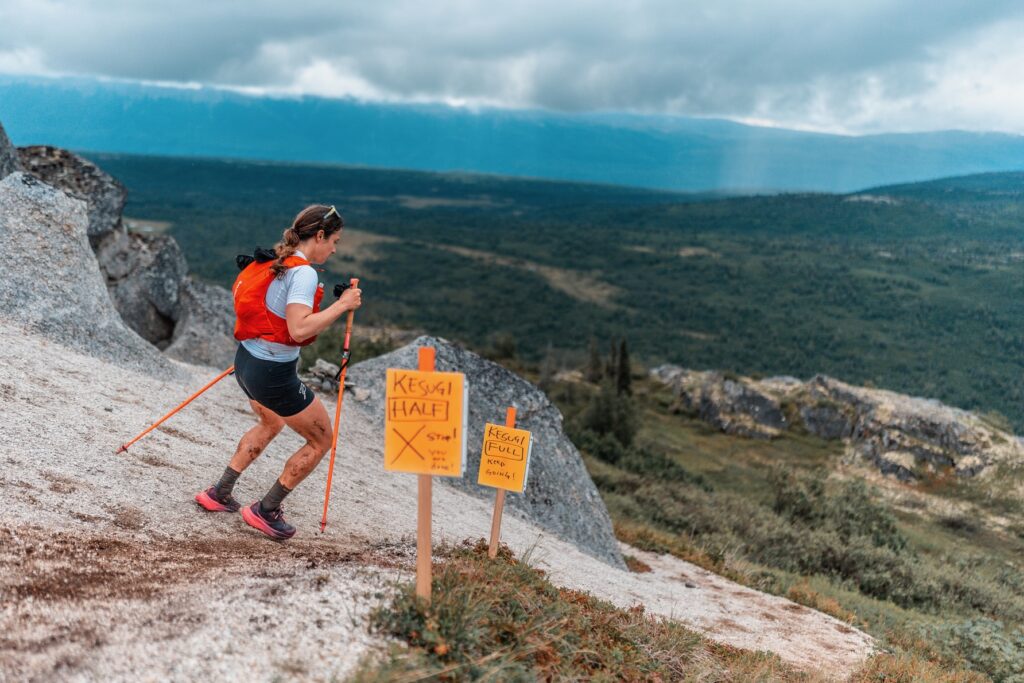
Name of the Race: K’esugi Ridge Traverse
Race/Event Distance: “Full” (50K)
Date: 8/8/2026
Describe the Event: The K’esugi Ridge Traverse is a spectacular and rugged point-to-point race through Denali State Park. The full traverse is about 31 miles, with roughly 6,000 feet of climbing, much of it above treeline on broad ridges overlooking the Alaska Range. There are no aid stations, and you have to carry a hat, gloves, windbreaker, long-sleeved shirt and pants, along with all the water, water purification, and food you need. Bear spray is optional — but highly recommended.
I ran much of the race with a very good friend from college, Lauren Rocco. We started in what turned out to be the perfect spot in the pack, settling into a comfortable pace in the single-file line up the initial climb, then gradually working our way forward over the first four miles and 2,000 feet of ascent. We started in cool, dense fog, which turned to steady light rain about an hour into the race. Just when I wondered if I needed to take out my gloves and jacket, the rain began to dissipate. Dark purple monkshood was blooming all along the course, the streams up high were flowing cold and crystal clear, and the ridge-top trail was primarily gravelly till, allowing for remarkably efficient running for many consecutive miles.
Around the midpoint, we passed through a surprisingly lively pass with several dozen spectators and race officials—including Lauren’s husband and kids, who had impressively hiked the 3.7 miles up to that point in under 3 hours to see us! It was a welcome moment of community before the geographic and mental low point of the course: a steep descent off the ridge into dense forest and bear country. The trail quickly became much wilder, with downed trees, mucky streams and marsh lands, sections so overgrown that the grass was above my head. There was plenty of cow parsnip, too. (Several of us later discovered the characteristic blisters the plant’s residue leaves on the skin after exposure to sun.) For a while, the only way I knew I wasn’t alone was the sound of other runners’ bear calls ahead and behind me in the brush.
The trail climbing back out of the lowlands was faint and overgrown enough that a group ahead of me attempted to follow a fork in what turned out to be the wrong way around a pond. (If the trail was going to have any markings or signage at all, this would have been a good spot!) Luckily, I had just started following them when they doubled back, and we all found the correct trail together, which was great timing, because it allowed me to catch back up with Lauren.
From there we began the long ascent back toward the ridge, first through more calf-deep mud pits and overgrowth and eventually across a few miles of granite slabs and more gloriously runnable tread. Reaching the high point of the second half felt like emerging into a new day. The course opened onto a broad alpine ridge dotted with lakes and wildflowers, with the morning’s fog and rain replaced by sunshine and expansive views. While Denali itself remained hidden until after I was off the ridge, the weather was getting better and better, and I found myself unable to wipe the grin off my face throughout this section of rolling descent.
Finally, I came to the last sixth of the course — steady switchbacks followed by a couple of miles of flat trail alongside Byers Lake toward the finish. For all K’esugi’s reputation as a difficult Alaska backcountry race, the course had more genuinely runnable miles of good trail, with minimal rocks and roots, than I could find in a month of running in New Hampshire’s White Mountains.
While I certainly didn’t set any PRs, throughout the race, I felt steady and incredibly grateful to be in such an amazing place.
How did you prepare for the race/event? My training was fairly minimal. After running the Sugarloaf Marathon in May (after only 8 weeks of real training, averaging 30 miles per week), I took 3 weeks of little to no running to recover, then switched over to almost all trail running, averaging 29 miles and 5900ft of vert per week over the next 8 weeks leading up to the race. I enjoyed visiting many of my favorite Vermont sections of the AT and had a few beautiful yet grueling days grinding through the Whites as well. For cross-training, I also swim 2-3 days per week and fit in a hike or a bike ride here and there.
Other preparation included figuring out how to carry bear spray in my pack, deciding on water purification, choosing which items to carry to satisfy the minimum gear requirements, and selecting what nutrition to carry on this self-supported traverse.
Any notable moments? There were some good post-race stories. We heard that one runner stepped into a mud pit, lost a shoe, and went fishing for it with an arm buried all the way to the shoulder—and still never found it. We are unsure how that person exited the course!
What do you wish you had known about this race/event before starting? I would have opted for iodine tablets to treat my water, instead of attempting to use a filter, which ultimately I was unable to use.